고정 헤더 영역

상세 컨텐츠
본문
반응형
"Trustworthy AI and Agentic RAG"
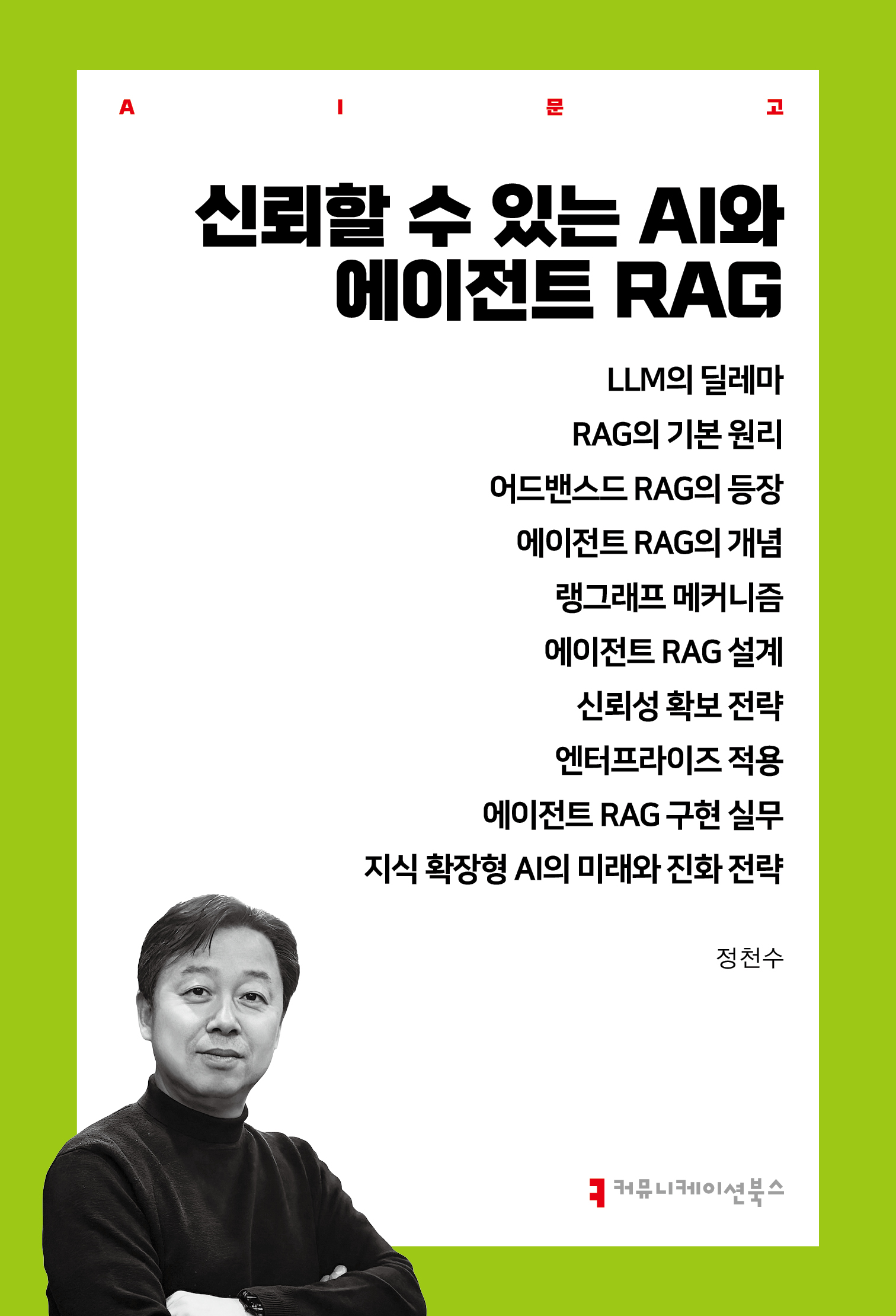
"The Path to Trustworthy Generative AI"
2023 was the year generative AI entered mainstream consciousness, with the generative AI chatbot ChatGPT capturing the world's attention. It was a year in which companies actively conducted Proof of Concept (PoC) projects to evaluate how to incorporate it into their operations. From 2024 through 2025, the conversation moved beyond a simple race for larger models. As practical adoption progressed in areas where capabilities had already been validated, focus naturally shifted toward how to secure trustworthy outputs.
Now, in 2026, generative AI is driving innovation across virtually every sector of society — finance, healthcare, education, entertainment, and beyond — as companies race to adopt generative AI chatbots and intelligent agents to boost productivity. The author has likewise led numerous PoC projects in search of practical enterprise applications, working toward real-world deployment.
The Rapidly Shifting Landscape of Generative AI
Amid this momentum, several noteworthy shifts are unfolding simultaneously in the generative AI space. These changes deserve attention precisely because they go beyond mere technical improvements — they are fundamentally transforming the role and purpose of AI itself.
First, LLMs are rapidly differentiating from general-purpose language models into reasoning-specialized and agent-optimized models. Until just a few years ago, the simple formula of "bigger models trained on more data are better" held sway. By 2026, however, distinct specialization paths are clearly emerging for individual models. Kimi K2.5, released in January 2026, champions an agent-first design and doubles processing speed through quantization techniques. In February, Claude Opus 4.6 introduced multi-agent capabilities via its Agent Teams feature, designed so that a lead agent and teammate agents share task lists and a messaging system to divide up complex work. That same month, Grok 4.2 pivoted toward multi-agent systems, while Gemini 3.1 Pro positioned Agentic RAG and advanced reasoning optimization as its core directions. The fact that major LLMs are simultaneously reinforcing agent capabilities and choosing specialized paths signals that the competitive frontier in AI has shifted from model size to real-world task execution.
Second, AI is transitioning from a "talking chatbot" to an "acting agent," becoming the central axis of business automation. OpenClaw, an open-source agent runtime that drew significant attention in early 2026, operates by receiving delegated authority from users and autonomously controlling PC applications — managing email, automating browsers, handling files — using messaging apps like WhatsApp and Telegram as its interface. It garnered explosive interest, recording over 145,000 GitHub stars immediately after launch. This demonstrates that AI has entered a phase where it goes beyond answering questions to actually producing results through web browsing, clicking, and executing code. Experts have described this as "2026: the year of the agent" (AI Newspaper, 2026). Anthropic has also lowered the barrier to AI adoption by launching Claude Cowork, which enables even non-developers to implement AI-powered workflow automation without writing a single line of code. An era has opened in which diverse members of an organization can design and operate agents directly, without needing specialized developers.
Third, following DeepSeek in early 2025, a second wave of AI disruption from China has arrived. Seedance 2.0, an AI video generation model released by ByteDance — the parent company of TikTok — upended the global content industry by producing cinematic, high-quality video from just two or three lines of instructions (iMBC, 2026). While it has been dubbed another "cost-performance shock" following last year's DeepSeek, allegations of unauthorized use of user data have also been raised (YTN, 2026). According to Hugging Face's analysis, downloads of Chinese AI models have already surpassed those of American models, and China's strategy of leveraging open source to build its own ecosystem represents not mere catch-up, but an expanding independent influence.
Fourth, in enterprise settings, a more fundamental question is emerging: how to achieve AI Transformation (AX) — a wholesale redesign of the entire organization around AI — rather than mere AI adoption. Three years into the AI boom, companies that report having generated significant business value through AI remain in the minority. Those claiming to have achieved enterprise-wide AI scaling are still stuck in the low twenties percentagewise (IT Daily, 2026). AX is not simply a matter of introducing AI solutions; it means restructuring data systems, infrastructure, and organizational operations in their entirety. The on-the-ground perspective that "attempting AX without having fully completed even foundational DX (digital transformation) means hitting a wall before you even start" captures this reality well.
The four converging trends — the agentification of LLMs, the emergence of acting AI, China's AI advances, and the practical barriers to AX — ultimately converge on a single shared question: "Can AI actually produce results we can trust?" This question is precisely the core problem this book aims to address.
The New Era of Artificial Intelligence: Light and Shadow
Technology is evolving at an unprecedented pace, yet that speed does not automatically translate into trust. Behind the dazzling technical advances, many challenges remain to be solved. The most representative of these is the phenomenon of hallucination. LLMs are remarkably adept at producing plausible-sounding sentences, but they carry the critical flaw of presenting factually incorrect information as though it were true.
There is also the problem of knowledge cut-off — the inability to reflect information that has emerged after a model's training date — as well as the issue of data freshness. The dilemma of extracting accurate answers while safely leveraging a company's sensitive internal data is another major reason many enterprises hesitate to adopt AI in the first place. Even so, the rapid advancement of generative AI and LLMs means we have already entered the practical-use stage in terms of the ability to understand and generate human language. Yet when organizations attempt to apply this technology to real business operations, the first wall they encounter is the question: "Can we actually trust it?" That a response sounds natural and plausible is an entirely different matter from whether the information is genuinely accurate, current, and accountable.
LLMs are, at their core, probabilistic language models. They store vast parameters as something like knowledge internally, but they cannot manage or update that knowledge the way an actual database can. New regulations, product information, legislation, and internal policies that emerge after a model is trained are not automatically reflected within it. Because of these limitations, many companies and researchers today are exploring ways to combine LLMs with external knowledge to improve reliability, rather than using them as isolated engines.
From RAG to Agentic RAG: An Evolution
The technology that emerged to overcome these limitations of LLMs is Retrieval-Augmented Generation (RAG). RAG first retrieves external documents relevant to a query and injects those results into the LLM alongside the prompt to generate a response. Even this simple idea goes a long way toward reducing the problem of models being trapped in outdated data and toward minimizing groundless hallucinations. But those who have actually tried applying RAG in real services quickly discover: "Just setting up a single vector store, retrieving documents, and injecting them in isn't as stable as you'd hope."
Indeed, early-stage Naive RAG had clear limitations. Recurring problems included retrieved information being used for answer generation even when it was irrelevant to the question, and complex queries being met with only fragmentary information (Meilisearch, 2025). To address these shortcomings, Advanced RAG emerged, and now we are entering the era of Agentic RAG, in which AI autonomously judges and acts. This approach — critically evaluating and revising search and generation results on its own — converges on a common perspective: rather than making the LLM itself smarter, the goal is to more precisely control the process of information retrieval, verification, and synthesis.
LangGraph: The Blueprint for Trustworthy AI
Agentic RAG is no longer a single-line pipeline of "retrieval → generation." It possesses an autonomous flow: first independently assessing the quality of retrieved information; if the evidence is deemed insufficient, refining the query and conducting additional web searches; and finally, at the last stage, checking whether the generated response contains any hallucinations. The key tool for implementing this kind of dynamic RAG is LangGraph.
The Agentic RAG and LangGraph covered in this book represent a new approach born from these developments. Where conventional RAG was a fixed pipeline following a predetermined sequence, Agentic RAG is closer to a graph-based RAG in which multiple agents sharing state selectively perform retrieval, evaluation, re-querying, web search, summarization, citation generation, and more, according to the situation. LangGraph models these workflows through Nodes, Edges, and State, making it possible to grasp complex processes at a glance and to trace and reproduce them whenever needed.
In real-world operations, operability and explainability are just as important as accuracy. When retrieval and generation are bundled together in a single black box, it becomes difficult to pinpoint where errors occurred, and improvement cycles inevitably lengthen. Using Agentic RAG and LangGraph, the flow can be broken down node by node, making it possible to record which query retrieved which document from where, by what criteria that document was filtered and re-ranked, and on what grounds the final response was generated. This goes beyond merely boosting model performance a little — it is the path to simultaneously securing the observability and verifiability required to design trustworthy AI systems.
Publisher: commbooks First Edition: April 9, 2026 Author: Jeong Cheonsu ISBN: 979-11-430-2335-3
반응형
'IT세상' 카테고리의 다른 글
| 2026년 AI 대전환: 단순한 챗봇을 넘어 '자율적 지능'으로 가는 5가지 핵심 이정표 (0) | 2026.02.26 |
|---|---|
| ‘삼성이 하면 다르다’, 생성형 AI시장도 공식 통할까 (1) | 2024.05.21 |
| 토큰 계산기, 문자수 계산기 (2) | 2024.03.05 |
| 새 정보시스템 구축은 `지뢰밭 걷기`…위험요인 다각도로 따져야 (1) | 2023.02.12 |
| SCM의 발전방향으로서 CPFR구축 설계방안 (0) | 2023.02.12 |


댓글 영역